WHAT YOU NEED TO KNOW
- The Air Force completed vertical stacking of an inert LGM-35 Sentinel missile at Vandenberg Space Force Base.
- The four month campaign verified missile stages, propulsion elements, the shroud, subcomponents, handling processes and field assembly capabilities.
- A completed design review found the missile’s maturity and hardware testing satisfied safety and mission assurance requirements.
- Initial flight testing remains planned for 2027, while the Air Force expects a Milestone B decision by the end of 2026.
The Air Force’s LGM-35 Sentinel intercontinental ballistic missile program has completed the vertical stacking of an inert missile, marking a major development ahead of initial flight testing planned for 2027.
The achievement confirmed that all subsystems remain on track for that next testing phase.
The program completed the work at Vandenberg Space Force Base in California, concluding a testing campaign that lasted four months.
The inert missile was assembled vertically as part of the effort.
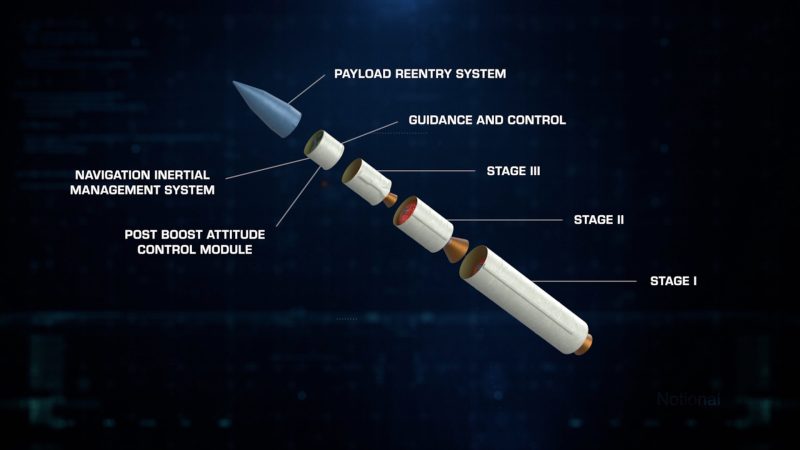
Testing verified the viability of the missile’s stages, propulsion elements, shroud and subcomponents.
Those pieces were assembled into a single configuration on a test pad, providing an integrated look at the developing weapon system.
The operation also demonstrated that personnel and handling processes could execute field assembly.
According to the Air Force release, the work verified segments of the weapon system’s operational lifecycle.
FREE Gun Law Map: Laws Don't Pause During Social Unrest
“From cross-country transport and specialized crane lifts to precision interface checks on the pad, bringing all of these elements together validated our technical baselines and proved Sentinel is ready to support the next phase of development,” Maj. Gen. William S. Rogers said in the release.
Rogers serves as the Air Force portfolio acquisition executive for Intercontinental Ballistic Missiles.
His statement highlighted the range of work required to move the missile, position its components and confirm the interfaces during assembly.
Along with the integration conducted on the pad, the program completed its first flight test design review. The Air Force Test Center’s 719th Test Squadron performed that review ahead of the planned 2027 flight testing.

The design review showed that the missile’s design maturity and hardware testing satisfy requirements for safety and mission assurance.
Combined with the stacking campaign, the review provided another significant marker as Sentinel moves toward flight.
The Air Force expects Sentinel to field its initial capability in the early 2030s.
The missile is intended to serve as a ground based deterrent for decades, according to the announcement.
“Sentinel is no longer conceptual or designs for what the nation’s next-generation ICBM looks like; it’s a physical, fully integrated system that is one major step closer to being ready for flight testing,” Gen. Dale White said in the release.
White serves as the Critical Major Weapon Systems director.
He described the completed integration as important progress while emphasizing that work on the strategic deterrent will continue.
“While this is a significant achievement, we will keep driving, firmly focused on delivering a modernized, credible strategic deterrent that will safeguard the nation and its allies well into the future,” White continued.
White also discussed the program during a media roundtable last week at the Air & Space Forces Association’s 2026 Air, Space & Cyber Conference. He told reporters that Sentinel remains on track for Milestone B.
That decision would allow the project to enter the engineering and manufacturing development phase.
The Air Force previously announced that the service expects to reach the Milestone B decision by the end of 2026.
“From a civil perspective, yes, we’re still on track for Milestone B,” White said during the roundtable.
“In fact, that is going very well. That was one of the areas I had concern early on about how you navigate those waters and make sure you get that recertification right.”
White said the program is parsing a large amount of data. The Air Force Cost Analysis Agency and the Cost Assessment and Program Evaluation have been integrated into that work, although the program’s cost remains uncertain.
“I don’t think we’re anywhere near a number right now,” White said. He nevertheless expressed confidence in what he had reviewed as the program continued examining the available data.
“I’m very comfortable with what I have seen though, and I think that we’re certainly within the realm of what we have talked about all along,” White said.
The completed stacking campaign now gives the Sentinel program a physical, integrated missile configuration rather than a concept confined to designs.
With the design review also complete, the Air Force is pressing toward initial flight testing in 2027 and the expected Milestone B decision by the end of 2026.
The opinions expressed by contributors and/or content partners are their own and do not necessarily reflect the views of BoredTrashPanda.com. Contact us for guidelines on submitting your own commentary.
Join the Discussion
COMMENTS POLICY: We have no tolerance for messages of violence, racism, vulgarity, obscenity or other such discourteous behavior. Thank you for contributing to a respectful and useful online dialogue.