WHAT YOU NEED TO KNOW
- The Cutter Storis completed a 133 day maiden Arctic deployment after conducting military, law enforcement and drone testing missions.
- Drones tested aboard the ship improved visibility for ice navigation and helped the crew maintain its intended station.
- The Storis demonstrated potential to refuel Navy vessels, possibly saving up to a week and a half of transit time.
- The crew spent about 300 hours monitoring four Chinese research vessels operating near Alaska’s Exclusive Economic Zone.
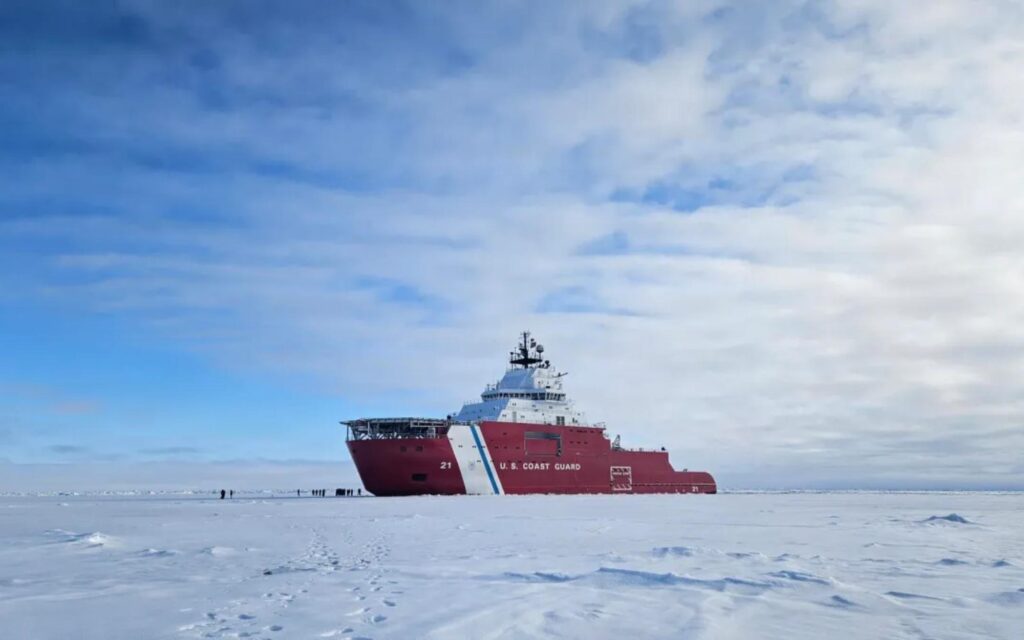
The U.S. Coast Guard’s first new icebreaker in nearly three decades returned this month from its maiden Arctic voyage after demonstrating military capabilities that could broaden the service’s options in an increasingly dynamic region. The Cutter Storis spent 133 days operating around the Arctic Ocean and Alaska.
Commissioned in August 2025, the Storis conducted missions that included law enforcement operations and live fire gunnery, some of which had not been performed in the region for decades. Capt. Corey Kerns said the deployment’s experiments and the ship’s built in features created new possibilities for Arctic operations.
Kerns took command before the vessel was commissioned. Personnel from the Coast Guard Research and Development Center and the Pentagon’s Defense Innovation Unit joined the deployment to test aerial drones, including models produced by Textron and Skyfront.
The flights examined how well the drones could withstand the severe cold of the high Arctic. They also revealed practical applications for helping the crew navigate through ice, a difficult task traditionally managed from the ship’s bridge.
For icebreaking, “a good aerial drone could be helpful,” Kerns said. “Piloting is something we still do from our bridges, but we’re seeing that technology used in ways to make it much more efficient to pass through the ice.”
The unmanned aircraft helped the Storis hold its intended station because “they can see out better and farther,” Kerns said. Coast Guard drones carried aboard the ship were less capable and did not perform as well in Arctic conditions.
The Storis is a converted commercial icebreaking vessel formerly named Aiviq, but the deployment showed it possessed “new capabilities we didn’t expect,” Kerns said. Its container storage areas could carry various payloads or expeditionary equipment, while multiple cranes provide logistics and maneuvering options.
“Now we’ll work with the partners to be like, ‘What’s on your dream sheet? What would you love for us to be able to do up there?’” Kerns said. “And I think we’ll be able to execute some of that. I think that was the biggest lesson learned: There’s more to it; we left a little bit on the plate, as it were.”
FREE Gun Law Map: Laws Don't Pause During Social Unrest
One significant additional mission could involve refueling U.S. Navy vessels operating in the Arctic. The Storis was originally designed to support an Arctic oil rig and possesses what Kerns described as expeditionary logistics capability.
During the patrol, the crew conducted a simulated refueling of a Coast Guard national security cutter. Kerns said the exercise showed the Storis could support a Navy destroyer if one needed fuel while operating in the region.
Its large storage capacity and ability to pump fuel into an oil rig could save a Navy vessel as much as a week and a half of travel and time away from its assigned station. Kerns said Arctic vessels face long distances to reach the closest refueling location.
MORE NEWS: Major Grocery Chain Axes Thousands of Americans While Shipping Entire Departments to India
Kerns cautioned that refueling would probably not become a routine Storis mission. However, he said the ship could serve as a fallback when national security requirements demanded that another vessel remain in the area instead of leaving to obtain fuel.
The five month deployment also included the first law enforcement mission conducted by a polar icebreaker in more than two decades, according to Coast Guard officials. The crew inspected multiple fishing vessels in the Bering Sea and conducted a joint boarding and fisheries plant inspection with the National Oceanic and Atmospheric Administration Office of Law Enforcement.
Preparing for that mission required specialized training and the addition of a maritime law enforcement specialist. The crew also practiced with the ship’s boats whenever open water allowed, although aging equipment and the Storis’s commercial layout created maintenance and operational challenges.
Military communications presented another concern after an earlier trip placed the Storis near Chinese research vessels without a direct, secure method for contacting senior officers during a possible crisis. The ship departed for its full deployment with improved communications, though Kerns said more work remained on its command and control systems.
During the Arctic mission, the Storis spent about 300 hours monitoring four Chinese research vessels that had not registered their planned activity with the United States. “So it’s a new competition space for us, and we’re just at the start of it,” Kerns said.
The Storis also allows the aging medium icebreaker Healy to concentrate on scientific research instead of military presence and monitoring operations. The Healy’s planned Arctic deployment this fall was canceled after a mechanical problem required it to be towed to Seattle, two years after an electrical fire forced cancellation of its 2024 deployment.
The Coast Guard expects to receive the first of three icebreakers built specifically for the mission around 2033. Kerns said the Storis demonstrated that future icebreakers must operate as vessels capable of performing multiple missions wherever civilian leaders require them.
The opinions expressed by contributors and/or content partners are their own and do not necessarily reflect the views of BoredTrashPanda.com. Contact us for guidelines on submitting your own commentary.
Join the Discussion
COMMENTS POLICY: We have no tolerance for messages of violence, racism, vulgarity, obscenity or other such discourteous behavior. Thank you for contributing to a respectful and useful online dialogue.